Just over three minutes into the opening of director Billy Wilder’s film noir classic Double Indemnity, insurance salesman Walter Neff (Fred MacMurray) pays an after hours visit to his place of work. The audience doesn’t know it yet, but Neff has been shot by his lover Phyllis Dietrichson (Barbara Stanwyck), and is returning to Pacific All Risk Insurance Company to record his dying confession. An elevator operator named Joe Pete (played by character actor John Philliber) lets Neff into the building, and takes him up to the twelfth floor. As Neff exits the elevator, the camera follows him into the main office of Pacific All Risk, and when he steps off to the side, we see a cleaning staff working late at night, long after everyone else has gone home.
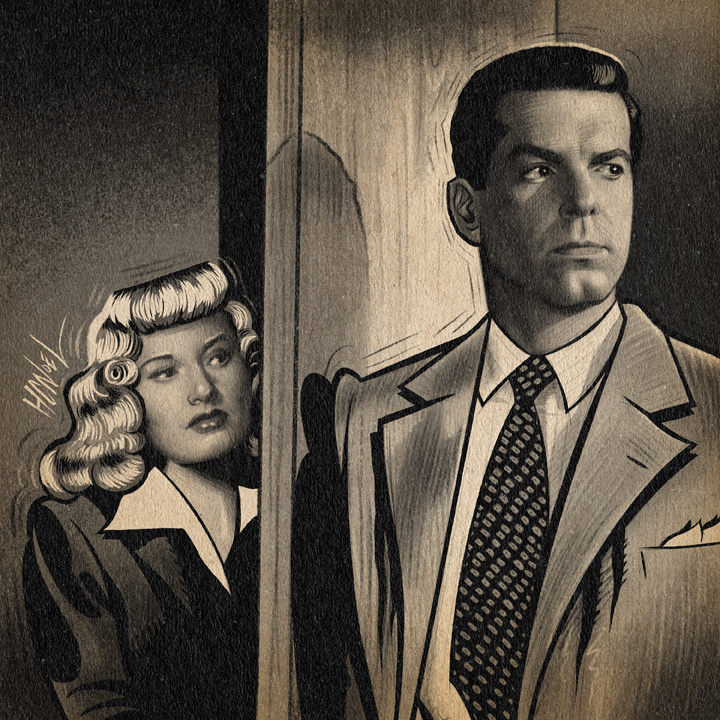
Barbara Stanwyck and Fred MacMurray – original illustration by Howie Noel.
The cleaning staff consists of two unidentified Black women and one Black man. The shot lingers on the man playing the janitor just long enough that it seems as if Wilder might actually want the audience to be aware of the actor’s presence, despite the fact that the character doesn’t have a single line of dialog. Yet for some reason, Wilder and director of photography John Sietz hold the shot on the janitor for approximately seven seconds—just long enough that he can be recognized as actor Clarence Muse. The janitor has no name, nor dialog, but he plays an important part in the film, because it is this anonymous Black man who calls Neff’s boss, Barton Keyes (Edgar G. Robinson), and tells the tenacious insurance claims investigator that there’s a man bleeding to death in the office.
Within the opening moments of Double Indemnity, Wilder has pulled us into an undisputed classic of the film noir genre. But more than that, with Muse’s brief, silent performance—which only lasts a few seconds—Wilder has quietly told the audience that Black people exist in this particular world. They may not have anything to say, and they may only be visible for a few fleeting moments, but they exist. And while few people realized it, Wilder was also setting up a significant work of racial propaganda. Unfortunately, if anyone saw Wilder’s brilliant subversion of the representation of Black characters in motion pictures at the time, no one mentioned it; nor has anyone mentioned it since the release of Double Indemnity in 1944. But that doesn’t change the fact that Wilder’s film is, arguably, one of the most revolutionary works of racial propaganda in the history of motion pictures.
Heeding the Call for Change…Kind Of
In order to understand the significance of Double Indemnity as a cinematic work of racial propaganda, there are some things you to need to know to place things in a proper context, starting with Wilder himself. Billy Wilder, whose birth name was Shumel Vilder, was a Jew born in Austria-Hungary in 1906. While still a teenager, Wilder started a career as a journalist in Austria, eventually relocating to Berlin in 1926, where he wrote for local newspapers, and began to develop an interest in filmmaking. Wilder established himself as a screenwriter, turning out screenplays for a dozen German films between 1929 and 1933, and making his debut as a director in 1934’s Bad Seed. With anti-Semitism steadily increasing in Germany and Adolph Hitler’s rise to power, Wilder left Europe and immigrated to the United States, where he quickly found work as a writer and a director. With all of that said, it is important to remember that while Wilder was not born American, he was proud to be an American citizen, and he was fiercely anti-fascist.
Based on author James M. Cain’s 1943 novella (originally serialized in Liberty magazine in 1936), Double Indemnity began filming in September of 1943. By this time, the United States was at war in Europe and the Pacific. Double Indemnity would be Wilder’s fourth film as a director, and this part is crucial, it was his first film set in the United States to be produced after the formation of the Office of War Information (OWI), a government-run agency tasked with the creation of propaganda intended to increase support for the American war effort on various levels. Elmer Davis, a former radio commentator turned director of the OWI was especially aware of the power of the entertainment industry. “The easiest way to inject a propaganda idea into most people’s minds is to let it go in through the medium of an entertainment picture when they do not realize they are being propagandized,” said Davis.
So…what does all of this have to do with Double Indemnity?
Well, by the time production had begun on Wilder’s film, support for the war effort was low within the African American community. Not only was much of America segregated, so too was the military, leaving many Blacks to question why they would support the war in any capacity. And this is where the OWI comes into play. The OWI conducted a study of Black characters appearing in films released between late 1942 and early 1943, and the results were disheartening to say the least. According the OWI’s findings, “Negroes are presented as basically different from other people, as taking no relevant part in the life of the nation, as offering nothing, contributing nothing, expecting nothing.” But that’s not all the study uncovered. Black actors appeared in only 23% of the films released by Hollywood during the time of the study, and of those films, 82% portrayed them as “clearly inferior” to whites.
Working with Wendell Wilkie, the chairman of the board of 20th Century Fox, and Walter White, the head of the NAACP, the OWI pushed the studios and producers to improve the depiction of African Americans in the movies. Gardner Cowles Jr., the head of the OWI’s domestic branch, stated that “unless the Negro is made to feel he is part of America we cannot expect him to be a good American.” And while the studios complied with the OWI’s Government Information Manual for the Motion Picture Industry, a guide that spelled out how the war and military were to be depicted in the movies, Hollywood was far more reluctant to change the roles for Black performers or how Black characters were depicted. While the film industry supported the war, the studios still capitulated to audiences in the southern states that regularly refused to show movies with Black characters.
There are no records kept of the films produced in the 1940s that followed the OWI recommendations for how to present “the Negro as a normal human being and integral part of human life and activity.” As a result, the only way to know what films and what filmmakers may have been doing their part to push the propaganda message of Black inclusively in America (though not necessarily equality), is to speculate based on what ended up on the screen. Casablanca would arguably be one of the most obvious examples of film that may have followed the suggestions of the OWI, but that film didn’t take place in the United States. What’s more, production on Casablanca had already begun before the propaganda agency was even formed, making it one of the films OWI included in its study of movies released in 1942 and 1943. Whether intentional or not, Double Indemnity has the distinction of being a film that followed the recommendations and suggested guidelines of the OWI more closely than possibly any other movie produced at that time.
The Unspoken Legacy of Black Actors in Double Indemnity
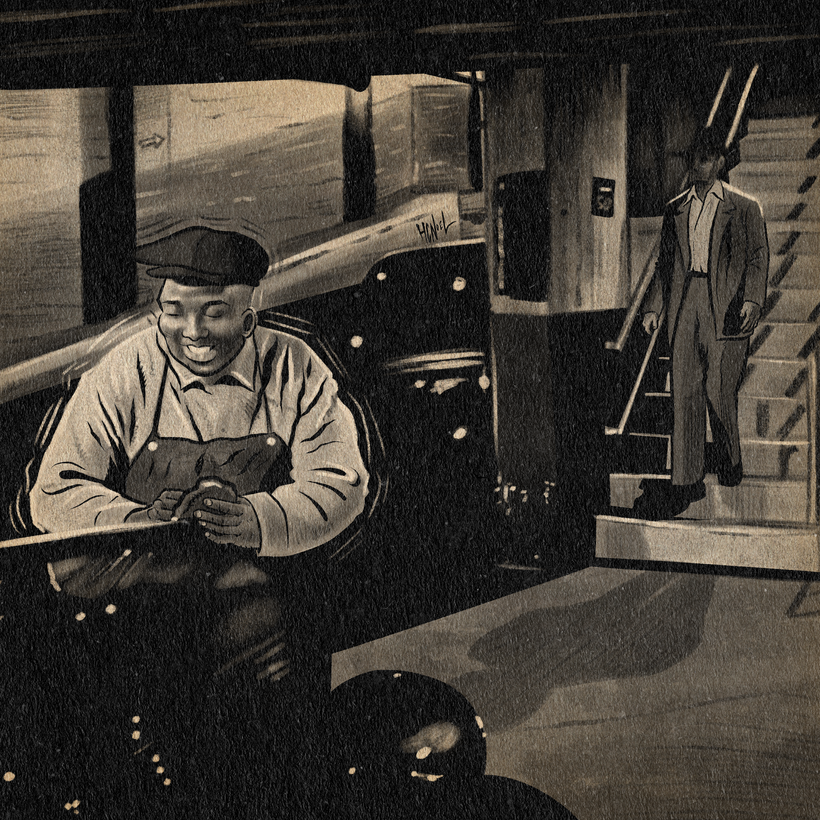
Sam McDaniel – original illustration by Howie Noel
Sam McDaniel, the first Black actor with a speaking part in Double Indemnity, makes the first of two appearances at a little over forty-seven minutes into the film. McDaniel, the brother of actress Hattie McDaniel (Gone with the Wind), plays Charlie the garage attendant, who is crucial in Walter Neff establishing an alibi for the murder he is about to commit. It is a small part—not much smaller than Joe Pete, the elevator operator—but it is crucial to the plot. Charlie could have been played by any number of white actors, but instead it was played by McDaniel.
Approximately six minutes after McDaniel’s appearance, five more Black actors show up in Double Indemnity as railroad porters—James Adamson, Billy Mitchell, Floyd Shackleford, Harold “Slicum” Garrison, and Oscar Smith, with Garrison and Smith being the only two with any dialog. For a Black actor to have one or two lines as a railroad porter was not unusual in films at that time, nor was it unusual to see an African American as a garage attendant. But what is specifically unusual about the all-too-brief performances of McDaniel, Garrison, and Smith is that none of them are played for laughs. And that’s where Wilder and Double Indemnity move assuredly past the stereotypical trappings of so many other films with Black actors in bit parts, and veers toward the kind of portrayals the OWI was requesting from Hollywood. Yes, railroad porters and garage attendants were stereotypical roles for African Americans in Hollywood, but none of the roles in Double Indemnity were played as stereotypes—none of them are comical. This is a clear and deliberate choice of the director that clearly and deliberately showed “the Negro as a normal human being and integral part of human life and activity.”
As near as I can tell, no one has ever written about Double Indemnity as a work of racial propaganda in film, and the reason for that is because it is done so well, with so much of the illusion that is filmmaking, that you barely notice it happening. There is a unique invisibility to Charlie the garage attendant and the two nameless railroad porters—an invisibility that comes when a filmmaker like Wilder chooses to not call attention to a Black character by making them out to be a fool, or milking them for a few laughs from the audience. And that’s kind of revolutionary. That said, Double Indemnity serves an equally important purpose that is even less obvious than its status as work of racial propaganda—it is an entry point into the nearly forgotten world of “Black Hollywood.”
Once Upon a Time in Black Hollywood
Despite being relegated primarily to playing slaves, servants, or jungle savages in studio films, there existed in Hollywood a community of Black performers that comprised a separate (and unequal) film community. Within this Black Hollywood there were a small handful of African American performers like Hattie McDaniel, Eddie Anderson, Mantan Moreland, and Stepin Fetchit who had achieved stardom in mainstream Hollywood, though they also played parts steeped in negative stereotypes. There were also musical performers and dancers that would make brief appearances in movies, usually during nightclub scenes. These were known as “specialty acts,” and their scenes were specifically designed to be cut from the film in southern states that didn’t want to see Negroes on the screen.
But aside from the few actors regularly cast in larger roles, and the specialty acts that were essentially disposable, the vast majority of African American performers in Hollywood were seen briefly in uncredited roles as domestic servants, porters, slaves, or jungle warriors, with little to no dialog. This is the reality of the seven known Black actors that appeared in Double Indemnity, who collectively had between them nearly 600 roles in film and television (no one seems to know a thing about the two women playing part of the cleaning crew). What’s more, all seven of the identified Black actors had crucial roles in the film industry. Let’s start with Clarence Muse.
Anyone could have played the part of the janitor, there were, after all, literally dozens upon dozens of Black actors in Hollywood at that time who worked regularly as background characters that never said a word. But by and large, Clarence Muse wasn’t one of those actors. Yes, he played more than his fair share of servants and porters and even jungle savages, but with a career going all the way back to the silent film era, Muse was a bonafide actor (by the time he made his cameo in Double Indemnity, he already had more than one hundred film credits to his name), Muse had come from the world of live theater, where he was a celebrated star, as well as the world of music where he’d made a name for himself as the composer of such hits as the jazz standard “When It’s Sleepy Time Down South.” In all-Black films like Hearts in Dixie, The Green Pastures, and Broken Strings, which he also co-wrote, Muse was a leading actor.
In 1934, Muse wrote and self-published a long-form essay entitled “The Dilemma of the Negro Actor,” earning himself a reputation as one of the most outspoken critics of the depiction of African Americans in the motion picture industry. Knowing this gives Muse’s silent cameo in the opening of Double Indemnity an underlying significance that is lost on anyone who doesn’t know him or his reputation. But in all likelihood, Billy Wilder knew Muse, and cast him for the same reason he holds the shot on the actor for a few seconds longer than is needed—the director was making a statement about the silent, nearly-invisible Black man in America. Wilder wants the audience to not just see Muse; he wants them to remember him. After all, the janitor is important to the story as the garage attendant played by Sam McDaniel—key plot points revolve around them.
Wilder was also making a statement with the casting of Sam McDaniel, which makes perfect sense, but only if you look at his performance as a subversion of racial stereotypes. With more than 200 credits to his name, McDaniel was one of the biggest “coon” actors in Hollywood. To be clear, I don’t mean that in a bad way…at least not that bad. McDaniel was good at what he did. He was a dependable actor, and he could deliver a line with great comedic timing and conviction. But the most important thing about McDaniel is that by and large he wasn’t recognizable to white audiences. Wilder didn’t want McDaniel’s crucial scene to be played for laughs, which means that not only did he not want a clownish coon in the role; he didn’t want someone recognizable as a coon. Stepin Fetchit would have been recognizable to audiences—white or black. The same is true for other more name-brand coons like Willie “Sleep-n-Eat” Best and Fred “Snowflake” Toones. McDaniel may have been recognizable to Black audiences, but most white film-goers wouldn’t know who he was, and they wouldn’t be expecting something comical from him. To them, Charlie the garage attendant would be nothing more than a regular guy. And a regular guy is what Wilder gave his audience.
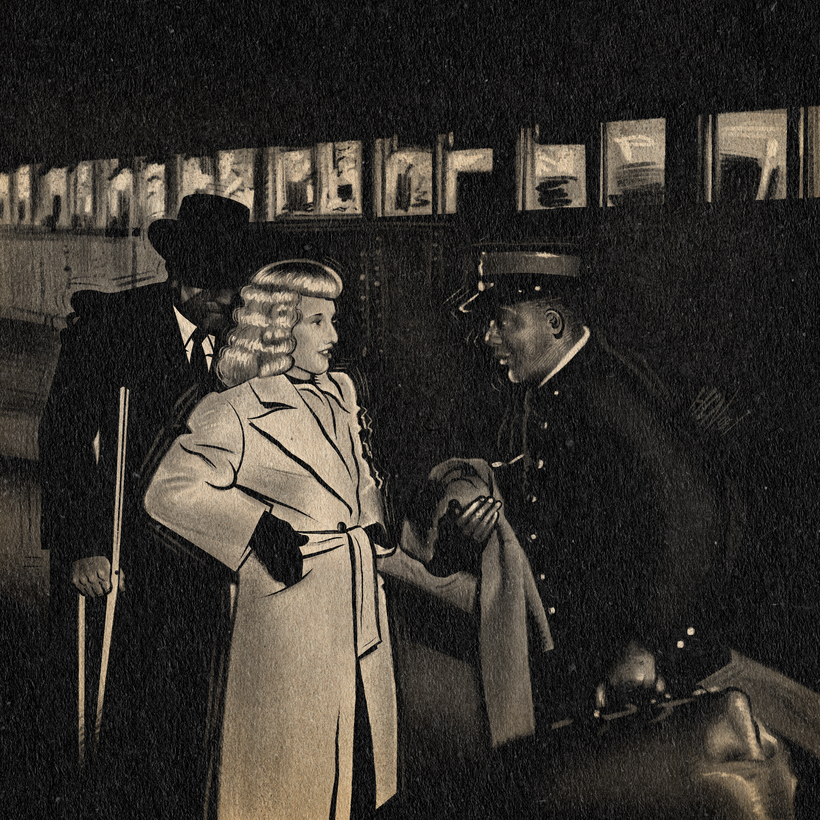
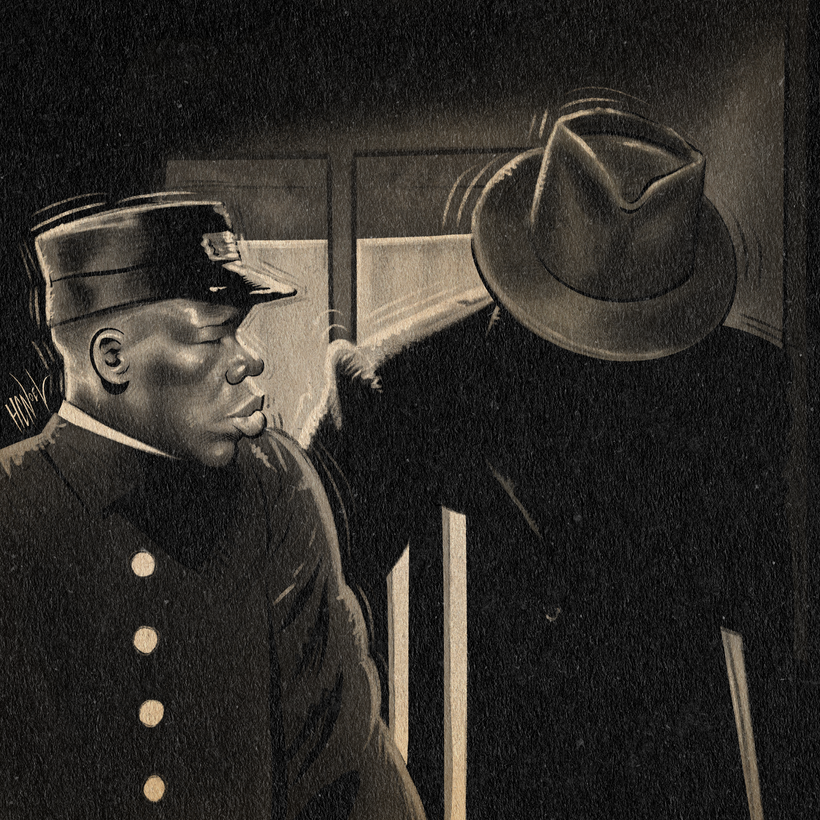
Harold “Slicum” Garrison – original illustration by Howie Noel
Once you understand how Wilder subverted racial stereotypes with McDaniel’s character, it becomes easier to see him do the same thing with the unnamed railroad porters with speaking parts, played by Harold “Slicum” Garrison and Oscar Smith. Neither of these parts is played for laughs, despite the fact that railroad porters were often played for comedic effect in films just as serious as Double Indemnity. It’s not that Wilder doesn’t want humor in his film; it’s that he doesn’t want humor at the expense of Black performers. Wilder uses Garrison and Smith to drive home the statement he made with Muse and McDaniel—that Black people can be in a film as people, and not as a source of laughs for the sake of laughs. But what is even more interesting about the choice to use Garrison and Smith is that in doing so, Double Indemnity cast two of the most powerful Black men in the film industry of the 1940s.
While Smith was more well known for his acting roles, he and Garrison were both what was known as “studio Negroes.” A studio Negro was something of a liaison between Hollywood productions studios like Paramount and MGM and the Black community. When MGM needed Black extras for a jungle movie or a plantation film, they could turn to Central Casting, which hired extras for all the studios, but they were just as likely to turn to Garrison, their studio Negro, who would venture into the Black community of Los Angeles to find extras looking to earn $7.50 a day (the average wage of an extra). Garrison had started at MGM as a “bootblack”—the operator of the shoeshine stand located on the lot in the 1920s. In 1929, Garrison was hired as an assistant director for MGM’s all-black film Hallelujah, directed by King Vidor. Garrison’s job was to work directly with the cast, which would lead to similar positions over the years. He was also rumored to have been involved in criminal activity ranging from drug dealing and pimping.
Much like Garrison, Oscar Smith operated the shoeshine stand at Paramount—a job he got after working as the personal valet and driver for actor Wallace Reid. A beloved fixture on the Paramount lot, Smith began working as an actor in the 1920s, and like Garrison, he became Paramount’s studio Negro. It’s worth noting that Double Indemnity was produced by Paramount, where Smith was both a contract actor, and ran the shoeshine stand well into the 1940s. In 1932, Garrison and Smith started their own casting agency, exclusively placing Black extras in big studio productions. While Garrison is more remembered for his less-than-legal activities, Smith is remembered for his work as an actor (he has more than 60 credits to his name), as well as his work in casting, his role as a beloved community leader, and a real estate developer. And while neither man was well known to the general public, Garrison and Smith were familiar figures in the film industry, so much so that Billy Wilder would have known both men by their reputations alone.
Oscar Smith – original illustration by Howie Noel
The casting of Garrison and Smith as extras with speaking parts in Double Indemnity is another statement about race in Hollywood being made by Wilder. As casting directors, Garrison and Smith helped place hundreds, if not thousands of Blacks in roles ranging from thankless to stereotypical. Smith himself managed the career of famed actor Willie “Sleep-n-Eat” Best, a performer almost as notorious as Stepin Fetchit when it came to playing comedic coons. But with their brief appearances in Double Indemnity, Smith and Garrison are a part of Wilder’s grand vision of changing the way Blacks were portrayed in films. Much like Muse in his silent role, and McDaniel in his performance as the witness to Fred MacMurray’s feigned innocence, Smith and Garrison play their parts not for comedy, but in service to the story, which gives their nameless characters a sense of humanity missing in so many other films.
Double Indemnity will forever be remembered as one of the greatest noir films of all time, and deservedly so. Likewise, Billy Wilder has earned his place in the motion picture industry as one of the best directors of all time. But both the film and the director are worthy of closer examination as it relates to the portrayal of race in America. At a time when Hollywood was being asked to change the way African Americans were presented in film, Wilder, more than almost any other director, and Double Indemnity, more than any other film, delivered the goods in a few brief seconds that most people failed to notice. And strangely, that was the point—no one was really supposed to notice, because the whole point was to not call attention to bestowing some semblance of humanity to African Americans. – David F. Walker
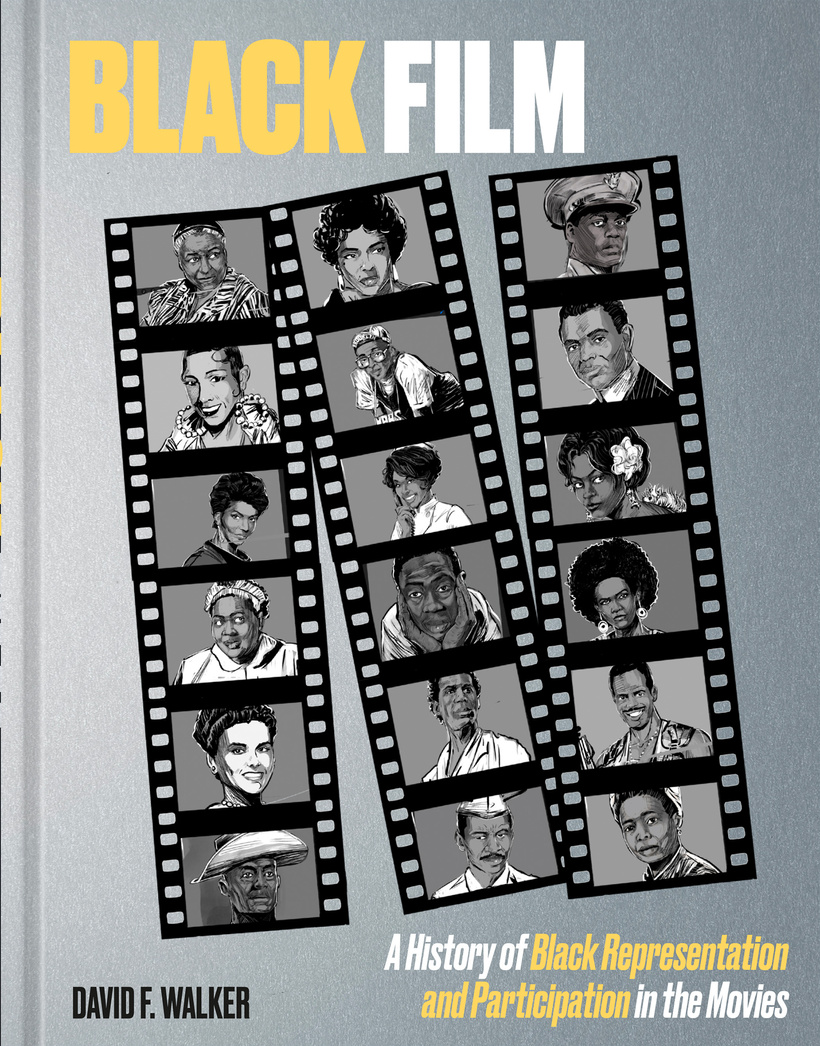
*portions of this essay appear in my book Black Film: A History of Black Representation and Participation in the Movies from Ten Speed Press, available wherever books are sold. Click HERE to order online.