by David F Walker | May 8, 2026 | News & Updates
Kinji Fukasaku’s career spanned five decades and spawned over sixty films, including Graveyard of Honor, Battle Royale, and the classic Battles Without Honor series. He is regarded as one of Japan’s greatest directors, and if his work were better known outside of his native country, he would easily be considered one of the greatest directors in the world. Best known for his yakuza films, Fukasaku reinvented the Japanese gangster genre with a series of gritty films in the 1970s. Before he turned the genre upside-down, Fukasaku had made slightly more conventional genre films like Wolves, Pigs, & Men and Japan’s Organized Crime Boss. But in 1970 the director began production on Sympathy for the Underdog which would prove to be the transition between the traditional chivalrous yakuza films of the past, and the morally corrupt anti-heroes that were to come in films like Street Mobster.
Originally meant to be a follow up to his earlier Japan’s Organized Crime Boss, Fukasaku reunited with lead actor Koji Tsuruta for a film with many similarities to their earlier collaboration, but with a unique style all its own. Tsuruta stars as Gunji, a yakuza gang leader released from prison after ten years. Gunji finds that his gang has long since broken up, while his key cronies have attempted to make it in the legitimate world by slinging noodles and raising families. Gunji and his men reform the old gang, but with all the territories in mainland Japan overrun by different yakuza families, they decide to make of go of it in Okinawa. They quickly build a reputation on the island, but soon find that the same deadly battles and rivalries that plague the yakuza on the mainland are also found on Okinawa.
In making Sympathy for the Underdog Fukasaku was heavily influenced by Gillo Pontecorvo’s seminal Battle of Algiers, a film that dealt with resistance in the face of occupation. Fukasaku himself was addressing the influence of American influence in Japanese culture, as Okinawa was the site of lingering military occupation by the United States. But even more than the influence of Battle of Algiers, Sympathy for the Underdog draws much inspiration from Sam Peckinpah’s The Wild Bunch. Tsuruta is clearly cast in the William Holden role, while his gang is very much like the aging outlaws struggling to keep pace with a world that has left them behind. There are even two pivotal scenes straight out of Peckinpah’s classic, including a bloody showdown between Gunji and his men and a small army of yakuza that have come to take over their territory.
Although its not my personal favorite film by Fukasaku, Sympathy for the Underdog is still a classic. And when watched in context with his other films, it shows a clear defining point when a master filmmaker made a serious transition in tone, content and theme, changing with him the face of modern cinema.
by David F Walker | May 8, 2026 | News & Updates
Jackie Chan’s first attempts to make a name for himself with American audiences in the early 1980s were less than spectacular. He starred in The Big Brawl, both of the Cannonball Run movies, and The Protector, none of which conveyed the charisma and talent that had established him as a star in Asia with such films as Drunken Master and Snake in Eagle Shadow. About the only thing those early American films did for Chan was introduce him to a dedicated fan base who sought out his Hong Kong films, and were then able to gloat knowingly about him when he finally made a huge splash in America with Rumble in the Bronx. The success of Rumble in the Bronx made Chan a viable draw with audiences in the United States, and in an effort to make a buck, many of his films were re-packaged for release in America. Between 1995 and 2000, some of Chan’s best Hong Kong films were released in the United States, often under different names, and frequently edited from their original version, as was the case with Police Story 3, a 1992 film released in America as Supercop in 1996.
Easily the most popular of Jackie Chan’s different films series, Police Story spawned four sequels and one spin-off. Supercop, the third film in the series, finds Chan returning as Inspector Chan, a Hong Kong detective with a knack for finding himself in deadly situations that often require him to perform daredevil acts of the most extreme insanity. This time around, Chan is recruited to work undercover and help mainland Chinese forces bust up an international drug empire. Chan teams up with Inspector Yang (Michelle Yeoh a.k.a. Michelle Khan), his equally adept female counterpart within INTERPOL. When Chan helps gang leader Panther (Wah Yuen) break out of prison, he gets in good with the criminal, who is the sinister henchman of the even more nefarious Chaibat (Ken Tsang). With Yang pretending to be his sister, Chan fights alongside Panther and the rest of the gang, earning their trust, until his cover is blown, leading to a dramatic showdown on the streets Malaysia.
Most people would agree that when it comes to Jackie Chan films, story and character take something of a backseat to the fights and the action sequences. If the story is at best easy to follow, or at least only mildly confusing, then that’s all you need as long as Chan delivers what he’s best known for, which is an incredible mix of comedy and action, and the outrageous stunts he performs, often at great danger to his wellbeing. Although the fight sequences are not as memorable as some of his other films, the stunt work is still more than impressive in Supercop. There is an incredible sequence with Chan dangling from the ladder of a helicopter as it flies through the sky, which leads to a fight sequence on top of a moving train. And not to be outdone, Yeoh also has some impressive moves as she hangs from the side of a truck racing through traffic, and jumps a motorcycle on top of the same moving train where Chan is fighting. The dynamic duo also has some noteworthy fights throughout the film, but the most memorable part of Supercop is the extended chase in the third act.
Although it’s not his absolute best film, Supercop does rank among Chan’s better movies, and it is certainly bolstered by Yeoh, who carries her own. The story gets silly and ridiculous, but that’s not exactly uncommon with Chan’s films, and fans of his work know exactly what they’re getting into with this movie.
by David F Walker | May 8, 2026 | News & Updates
French critic-turned-filmmaker Christophe Gans’s 2001 film Brotherhood of the Wolf was a cinematic wet dream for fanboys–a moving picture pastiche of genre films with a childlike love for all things cool. In much the same way Sergio Leone’s A Fistful of Dollars and Ang Lee’s Crouching Tiger, Hidden Dragon captured both directors love for the genre films they grew up watching, Brotherhood of the Wolf is Gans’s loving tribute to the spaghetti westerns, kung fu flicks and horror movies that inspired him in his youth.
Set in 1765, Brotherhood of the Wolf combines fact and fiction to create a pre-French Revolution political thriller fused with a horror mystery–that may or may not have supernatural overtones–all wrapped up in an action-packed, romantic kung fu revenge film. The film uses the real-life tale of the Beast of Gevaudan, a mysterious creature responsible for attacking more than 100 people, as the focal point. For King Louis XV, the Beast was a source of embarrassment, and a symbol that he was incapable of effectively ruling or protecting his subjects. That much of the film is true, but reality gives way to fantastic adventure and political intrigue as Gans introduces Gregoire de Fronsac (Samuel Le Bihan), a naturalist dispatched by King Louis to capture and kill the creature. Having seen his fair share of action during a campaign in New France (Canada), Fronsac is more a man of intellect than of outright action. Fransac likes to leave the asskicking to Mani (Mark Dacascos), his Iroquois blood brother and Kato to Le Bihan’s Green Hornet.
When Fronsac and Mani arrive in Gevaudan, they find a group of men terrorizing a woman and an older man. Mani dispatches the men in a martial arts-like battle that sets the tone for the rest of Brotherhood of the Wolf. This is clearly not a standard period-piece costume drama. Within the first few minutes of the film, Gans manages to work in references to Planet of the Apes, Jaws, Sergio Corbucci’s spaghetti western classic Django, and the films of Bruce Lee. And as the film progress, the references don’t stop, with Brotherhood paying loving respect to everything from the martial arts epics of Shaw Brothers Studios to the British horror movies of Hammer Films.
The local villagers, and the soldiers dispatched by the king, believe that the Beast is a wolf, but Fronsac is convinced otherwise. He suspects there is more going on than meets the eye, and he soon becomes caught up in a web of political deceit. Complicating matters is his love for the beautiful Marianne de Morangias (Emilie Dequenne), the sister of Jean-Francois de Morangias (Vincent Cassel), who holds a dark secret connected to the Beast. When Fronsac and Mani fail to capture the Beast, the king dispatches Beauterne (Johan Leysen) with orders to simply capture a wolf, and have Fronsac pass it off as the actual Beast. But when the killings continue, Fronsac and Mani return to Gevaudan to deal with the deadly killer once and for all.
Working with an international cast and crew (including fight coordinator Philip Kwok and editor David Wu, both John Woo collaborators), Gans has crafted an action film that transcends genres and nationalities. The end result is a tale of universal heroism that is, if nothing else, a cool movie. Some people had trouble wrapping their brains around Gans’s everything-and-the-kitchen-sink approach to making Brotherhood of the Wolf, while others found it to be a fun bit of escapist entertainment. Brotherhood of the Wolf is not, by any stretch of the imagination, a cinematic masterpiece on par with something like Citizen Kane, but it is very, VERY entertaining. The action sequences are worth the price of admission, the Beast is awesome, and Dacascos, a total badass, steals ever scene he’s in. Le Bihan and Cassel are pretty cool as well, and co-star Monica Bellucci certainly makes things easy on the eyes.
When all is said and done, the movie feels like it was made by a child who had run amok in some sort of cinematic toy store of his dreams. Gans is determined to create the ultimate genre hybrid–a film unencumbered by borders (or at times, logic) Think about it: This is a film that features a Hawaiian actor playing a Native American who uses martial arts in 18th-century France while hunting a creature that may be a werewolf. But somehow, whether through sheer determination or simple love of genre films, Gans succeeds in crafting a film that is captivating, drawing the audience in and reminding you of what it was like to be a kid watching a movie that is just plain cool.
by David F Walker | May 8, 2026 | News & Updates
by David F Walker | May 8, 2026 | News & Updates
This is the first original comic strip that I ever wrote and drew. Up until this point I had either started comics and given up before finishing, or I copied what I saw in the newspaper (some of which I’ll be posting). But this right here is a joke that I came up with on my own, and drew (without any tracing). I was eleven years-old at the time, and very proud of myself. To this day, I remember the great feeling I had after finally completing something I started. As a creative, few things can compare to the feeling you get when you finish whatever it is you’ve started.
by David F Walker | May 8, 2026 | News & Updates
If you are a true fan of martial arts flicks, then you no-doubt have seen this film in at least one of its several incarnations, which includes the alternate titles Master Killer and Shaolin Master Killer. If, however, for some strange reason you have never seen this movie, then you can’t, in any way, shape or form, consider yourself to be a true die-hard fan of kung fu films. As harsh as that may sound, the reality is that for every genre and sub-genre of film you can imagine, there are only a very small handful of films that are essential viewing within that particular group. The 36th Chamber of Shaolin is one of those films.
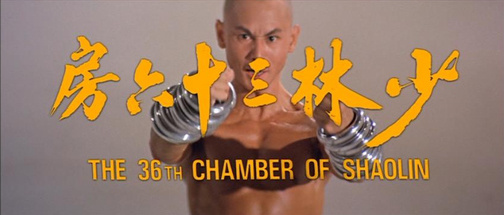
With the popularity of Bruce Lee and films like Five Fingers of Death (a.k.a. King Boxer) in the early 1970s, there was a flood of chop sockey cinema that was dumped in inner-city and Chinatown movies theaters all the way into the 80s. Produced by the legendary Shaw Brothers studio, The 36th Chamber of Shaolin was one of these countless films. It had been a huge hit in Hong Kong, before it was edited, dubbed and released in the United States under the title Master Killer. At the same time films like Master Killer were being played in double and triple and quadruple features at rundown theaters and drive-ins, local television stations were still airing feature films during the day on Saturdays. Many stations, including Channel 5 in New York, and Channel 12 in Portland, where I moved when I was in junior high, began showing kung fu films, including Master Killer.
Like so many others who had become fascinated with kung fu films in the 1970s, I watched Master Killer simply because it appeared, at least as first glance, to be more of the silly, asskicking entertainment that made up many of my Saturday afternoons. But the reality is that the film was very different from all the others I had seen, and was really the only one to make any sort of lasting impression. Years later, when I went back and started rewatching martial arts films, this was the film I wanted to see again. When I finally saw it as The 36th Chamber of Shaolin, probably a decade or more later, it was totally familiar, while at the same time a completely new experience.
The plot of 36th Chamber comes from the standard template of Hong Kong’s cinema of vengeance. Gordon Liu stars as San Te (although his name at the beginning is Liu Yu-te), an unassuming student who witnesses the brutality of the Manchus as nefarious General Tien (Lo Lieh) kills a rival. This prompts Liu to become involved in the rebellion to overthrow, but the cost of his involvement is the massacre of his family. With nowhere else to go, Liu flees to the Shaolin Temple, hoping that the monks there will teach him the kung fu skills he needs to avenge his family. At the temple Liu is renamed San Te by the monks, and he eventually begins the difficult training that involves mastering all 35 chambers used to teach the Shaolin kung fu.
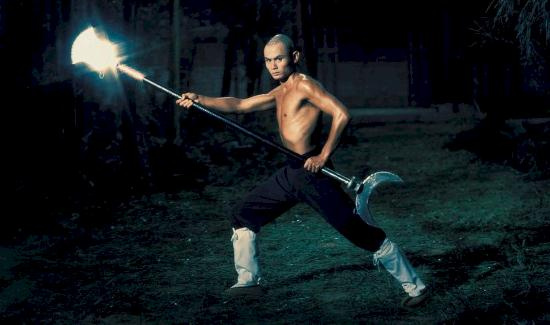
A standard element in many martial arts films was the obligatory “training” sequence where a student of questionable skills eventually learns to become a master. The 36th Chamber of Shaolin took this standard convention, and turned it into the foundation of the film’s second act. Where a training sequence may have lasted somewhere around 10 minutes in another film, 36th Chamber uses the concept and turns it into a way of charting the growth of San Te’s character. In scene after scene of some of the most memorable moments to grace Hong Kong cinema, San Te masters one chamber after another, quickly moving toward his goal of becoming a fighter who can take revenge for his family. But as he masters each skill involved with the individual chambers, San Te begins to grow as a person, profoundly influenced by the Buddhist teachings of the Shaolin monks. When he finally has moved through all the chambers, and passed his final test, San Te is given the opportunity to oversee the instruction at any of the 35 chambers. Instead, he asks to create a 36th chamber, one that can be used to teach kung fu outside the temple to everyday people, so that they may protect themselves from the tyrants who rule the land.
What is profound about The 36th Chamber of Shaolin is that while it follows many of the conventions established in other martial arts films, it moves beyond those standard trappings. In countless other movies San Te would have simply learned to fight and gotten his revenge. But director Liu Chia-Liang (a.k.a. Lau Kar-Leung) takes the genre to another level by developing San Te’s consciousness along with his fighting skills. This is evidenced by the protagonist’s journey from wanting to merely exact vengeance for the death of his family to his desire to teach others, so that they may protect themselves and fight against oppression.
The most popular heroes of martial arts films were always the flawed and the oppressed that grew into greatness through much trial and tribulation, despite their weakness. But at the same time, it was always difficult to find much depth or dimension within a majority of the martial arts heroes of Hong Kong films, especially as they played in the U.S., heavily edited and poorly dubbed. In making the journey to America, many films lost whatever heart and soul they may have had–if they had any in the first place. But no editing or poor dubbing was able to remove the heart and soul from 36th Chamber of Shaolin, and even as Master Killer, it emerged as a classic with the genre.

 Unlock with Patreon